
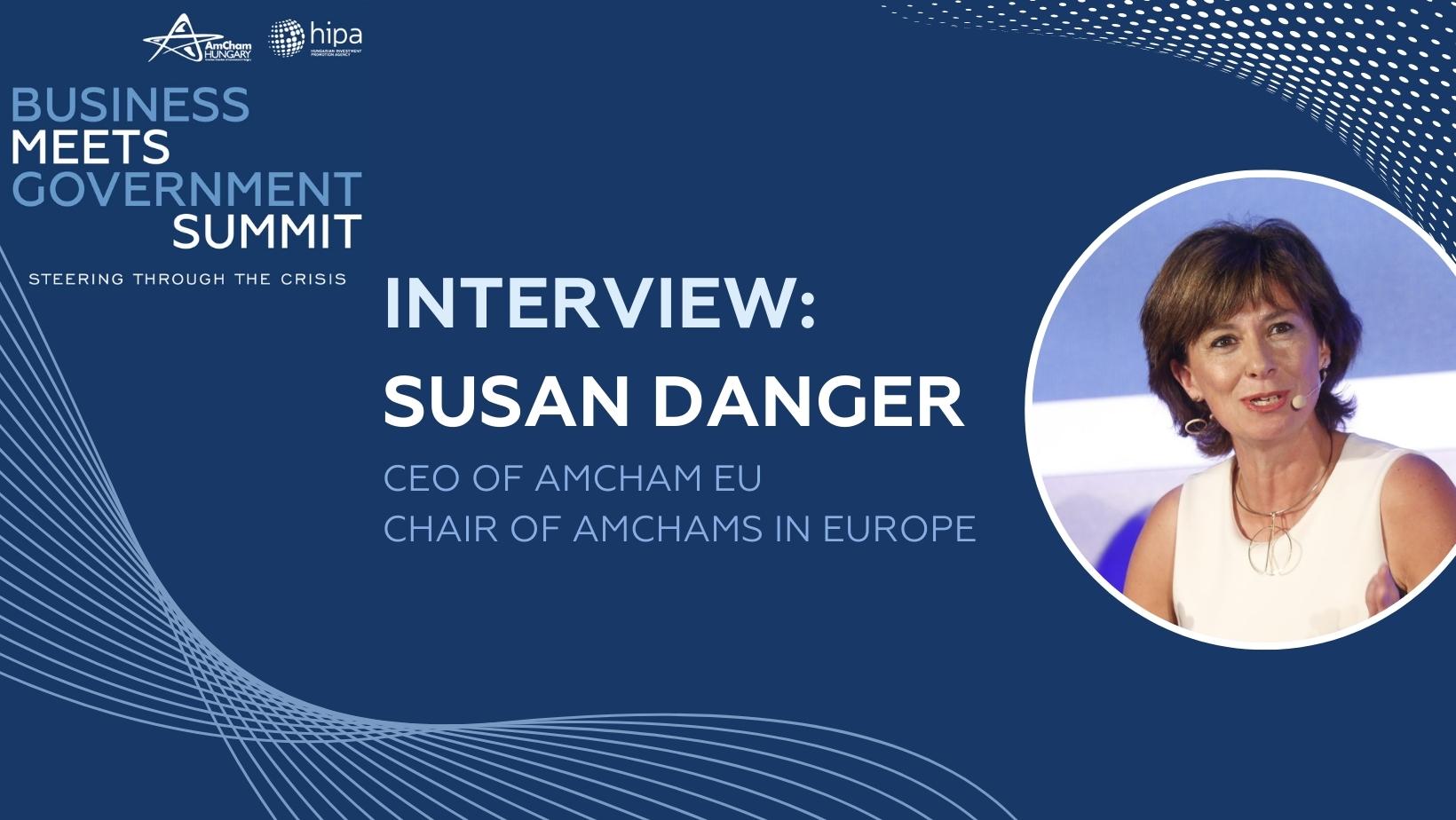
Before the VIII. Business Meets Government Summit, we had a quick chat with Susan Danger, CEO of AmCham EU and Chair of AmChams in Europe, one of the key speakers of Monday's conference.
AmCham: As CEO of AmCham EU, and Chair of ACE, you are in a unique position to work with chambers and business leaders across the continent. What are the key challenges which impact members across Europe? How can AmChams help mitigate the crisis?
Susan Danger: The world is currently facing a great set of challenges, including the war in Ukraine, skyrocketing inflation, the compounded energy and food crisis as well as the disruption of global supply chains. In times like these, all sectors of society must work together to create a stable economic ecosystem in which we can all work and live.
As nonpartisan organisations, the AmChams are ideally positioned to be the bridgebuilders between governments and businesses on both sides of the Atlantic. In Europe alone we represent the interests of more than 17,000 American and European companies that employ more than 20 million workers and account for more than €1.1 trillion in investment on both sides of the Atlantic. The complex and volatile external environment will require all segments of society to work together to address these global issues.
AmCham: Can you tell us about the state of the transatlantic relationship between Europe and the US under the President Biden?
Susan Danger: Under the Biden Administration we have seen a wide range of initiatives designed to advance the transatlantic relationship and rebuild trust for both partners. For instance, the Trade and Technology Council was established as a unique forum for the EU and the US to shape the global economy’s future direction around the values of democracy, rule of law, open trade and fair competition – it embodies the renewed cooperative spirit on both sides of the Atlantic.
Most recently we have been encouraged by the Executive Order issued by President Biden to implement the EU-US Data Privacy Framework. This is an important step in restoring confidence in the ability to transfer data across the Atlantic.
In all aspects of their relationship, the EU and the US have demonstrated renewed and revitalised optimism since the start of the Biden Administration, and the recent global challenges have only added a renewed sense of urgency to this partnership.
AmCham: How can businesses champion the transition of Europe into a more sustainable economy?
Susan Danger: Companies are playing an active role in the transition towards a greener economy. By developing low carbon technologies, supporting green finance and reducing its environmental footprint, industry can contribute to climate change mitigation worldwide. Already today, the private sector has demonstrated leadership in the development of more sustainable practices. It is also more evident than ever that affordability and reliability of energy supply is vital for a competitive and sustainable industry in Europe, and there is a legitimate expectation for the private sector to do its part. Reducing energy demand and transitioning to low-carbon technology have been and continue to be key components of industry’s efforts.
Going forward, companies will need to secure investments to effectively continue to decarbonise their operations in a post-crisis environment. But we also need our leaders in government to invest in the technology and infrastructure that will help our economies thrive and keep our planet safe. With clearly defined targets, and a path for achieving them, businesses can continue to be constructive partners in the definition and implementation of climate policies.
Here, allow me to plug our #EUGreenway campaign, where you can find more examples of our member companies innovating for a more sustainable future: https://www.investedineurope.eu/green-way/.