

The boundaries between work and leisure are becoming increasingly blurred. Hybrid work, a more flexible work culture, and changing employee expectations have introduced a new trend to the world of business travel: “bleisure.”
Bleisure, a term created by combining the words business and leisure, means that an employee extends a business trip by a few days and adds rest, sightseeing, or other leisure activities after the professional program.
What used to be an exception is now becoming a natural expectation, especially among younger generations. According to Business Travel News’ 2025 international research, 51% of business travelers extend their business trips with personal activities “very often” or “as much as possible,” while another 28% do so occasionally. This means that nearly 80% of business travelers combine work with leisure experiences at least from time to time.
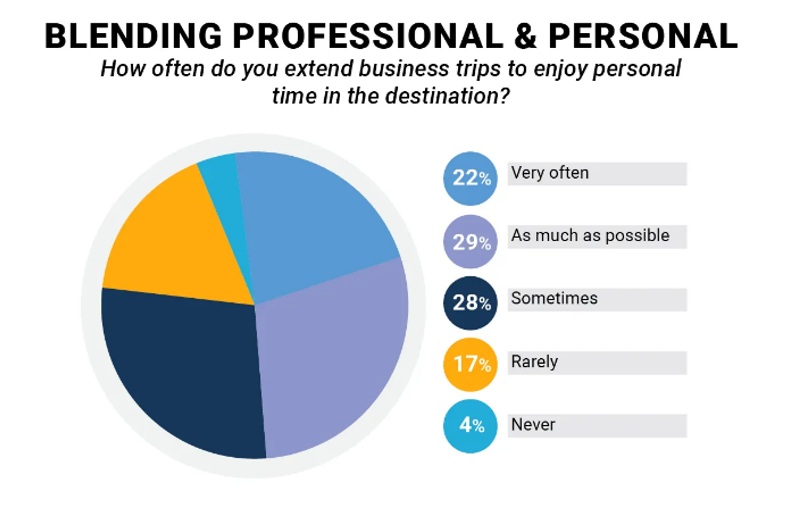
Source: Business Travel News – Business Traveler 2025 Research
Why Is Bleisure Becoming More Popular?
The role of business trips is changing. In-person meetings, conferences, and client meetings remain important, while employees are also placing greater emphasis on the travel experience and their well-being.
According to international business travel research, a growing share of companies support bleisure opportunities because they have a positive impact on employee satisfaction, work-life balance, and employee retention.
GBTA’s (Global Business Travel Association) 2025 survey supports this with data. At companies that support bleisure travel, 71% of respondents reported improved employee satisfaction and well-being, 68% reported better work-life balance, and 52% said employees were more willing to travel for work.
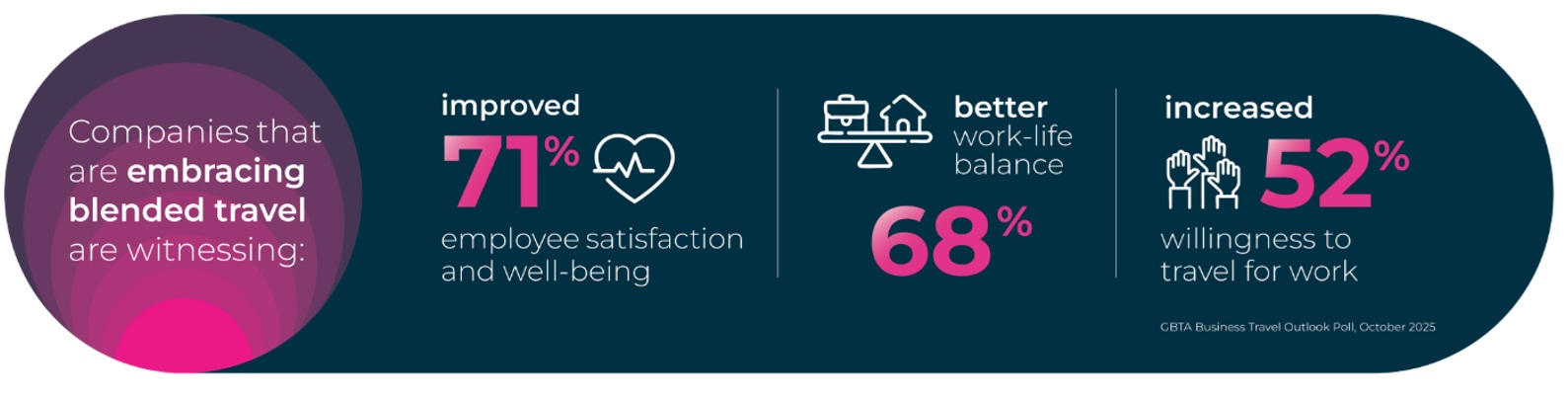
Source: GBTA Business Travel Outlook Poll 2025
Flexibility and the opportunity to gain new experiences are especially important for younger generations. For them, business travel is not just an assignment, but also an opportunity to discover new places and cultures.
More Comfortable Business Travel Is a Business Advantage
Employee well-being is no longer just an HR issue; it is a business factor. More and more research shows that the quality of the travel experience directly affects satisfaction and performance.
According to Business Travel News research, more than three-quarters of business travelers feel that travel contributes to their professional success and career development. The survey also found that employers offering greater flexibility during travel are viewed more favorably by their employees.
When an employee can spend a few extra days at the destination after an intensive business trip, they often return more rested, more motivated, and with more positive experiences. In this way, the enjoyable and the useful are not alternatives to each other; they can reinforce each other.
Bleisure Is Not a Reward Trip
At the same time, it is important to clarify that bleisure is not a company-funded vacation.
In most cases, the company covers only the costs of business-related travel, while the employee is responsible for the costs of the extended stay and leisure activities. The essence of bleisure is not a free vacation, but the possibility of adding personal time around a business trip within transparent and well-regulated guidelines.
That is why it is important for companies to define clear rules regarding costs, insurance, liability, and approval processes. According to international surveys, companies that use bleisure programs primarily establish detailed policies in the areas of cost management, employee safety, and insurance terms.
What Does This Mean for the Future of Corporate Travel?
Bleisure is no longer just a trend; it is one of the defining elements of modern business travel. Companies that manage this phenomenon thoughtfully can strengthen their employer brand, increase employee satisfaction, and gain a competitive advantage by reducing turnover.
Research clearly shows that a significant share of business travelers already combine work and leisure, while companies are increasingly recognizing its positive impact on well-being, engagement, and willingness to travel. According to GBTA research, 71% of organizations that support bleisure have experienced improved employee satisfaction, 68% have seen better work-life balance, and 52% have reported a greater willingness to travel for business.
The question today is no longer whether bleisure will appear in corporate travel, but how it can be incorporated into travel programs while keeping the balance between company and employee interests in mind.
For more details or business travel advice, please check out our website: https://www.wecotravel.hu/Eng/ or contact us at: sales [at] wecotravel.hu (sales[at]wecotravel[dot]hu)