
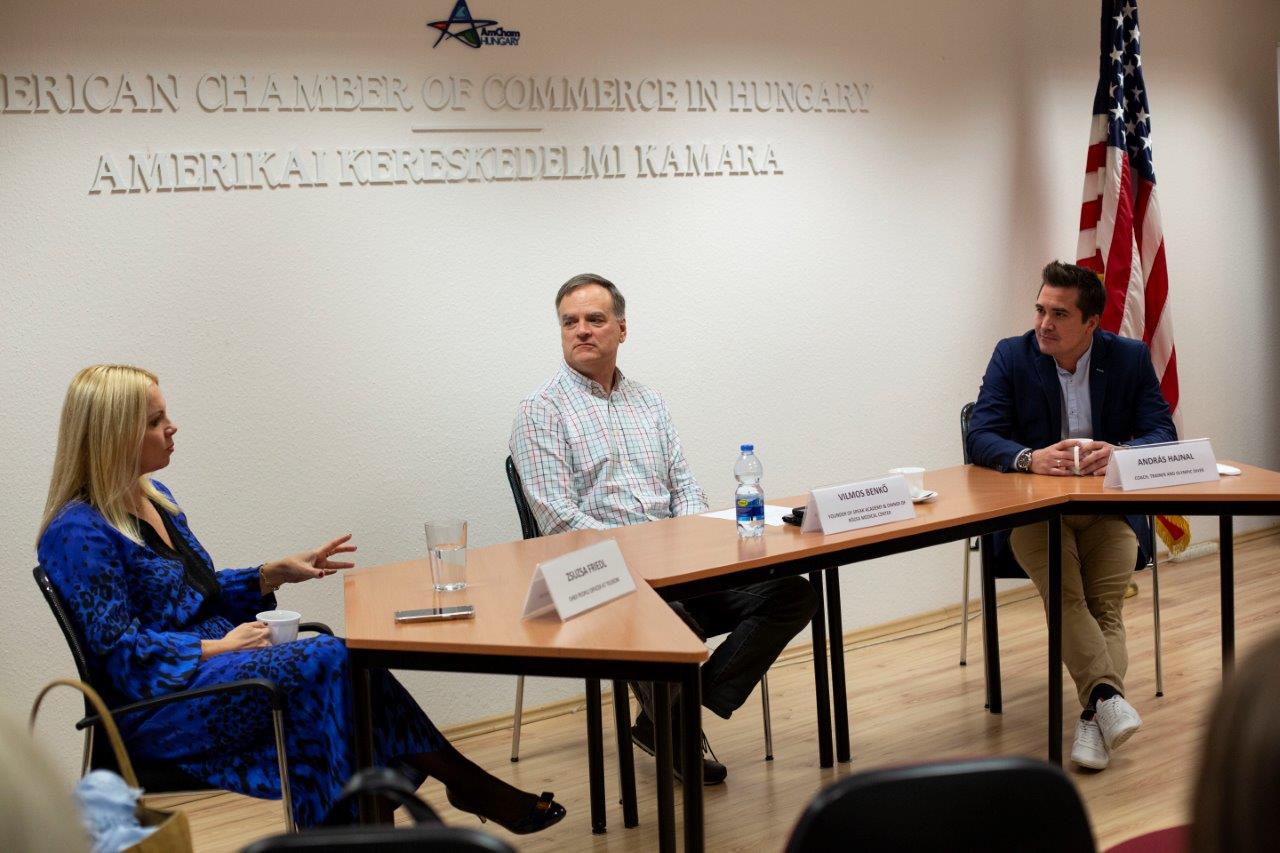
On 2 November, AmCham held the second session of our returning HR Academy at the AmCham Office, an event series that aims to address the most pressing issues HR leaders face today and showcase best practices and tools from industry leaders to help prepare the foundation of HR professionals’ post-pandemic success. This time, our guests were Zsuzsa Friedl, Chief People Officer at Telekom, and András Hajnal, coach, trainer, and former Olympic diver. The discussion focused on the current most important questions and challenges regarding Performance & Talent Management, and was moderated by Vilmos Benkő, entrepreneur, founder of SPEAK Academy & owner of Rózsa Medical Center. Our audience also provided crucial contributions to the discussion.
Talent acquisition and management is a challenge most companies face continuously. Therefore, the question of ‘who is a talent’ is always present – as such, this was Mr. Benkő’s first question to our speakers.
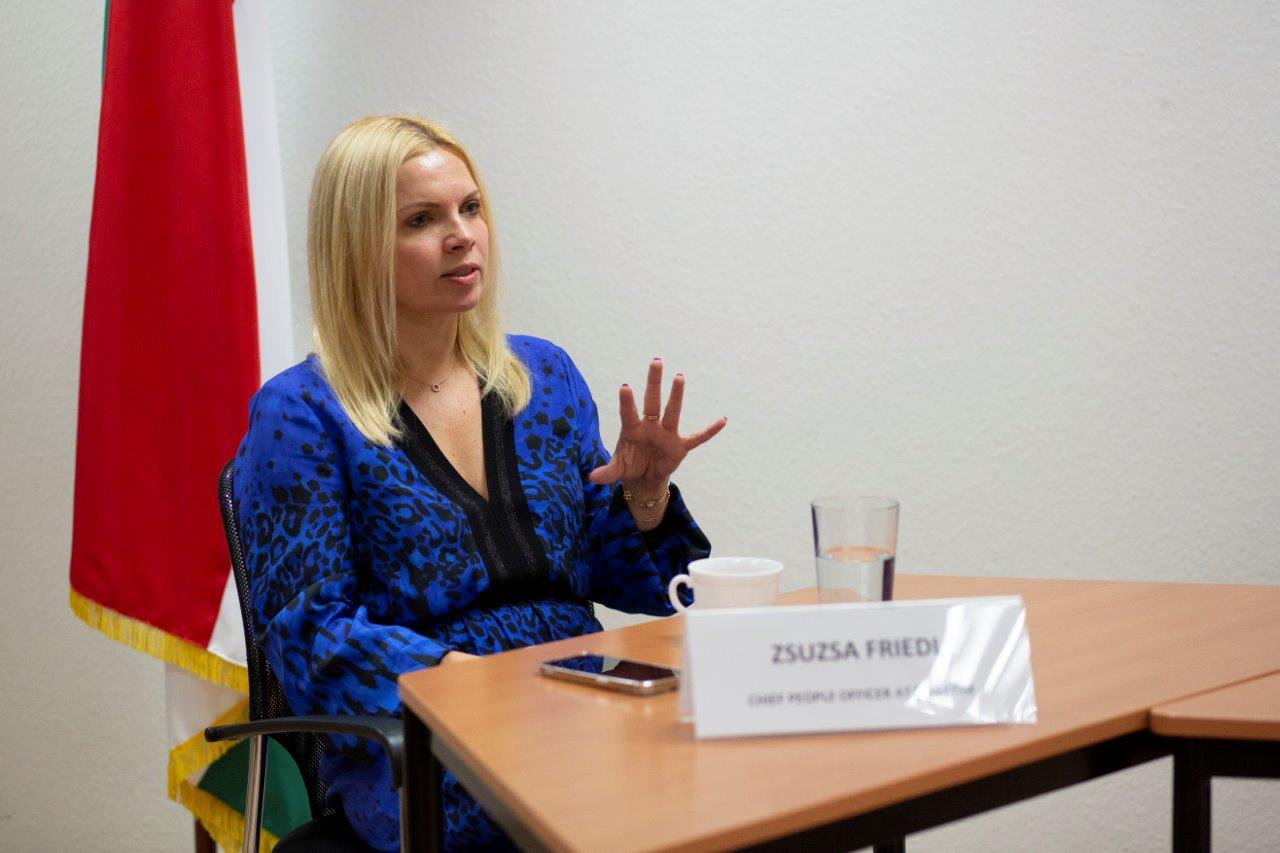
For Ms. Friedl, the term ‘talent’ denotes anyone and everyone who works at her company, and she stressed that this is an important distinction to make. HR professionals can also ask the question: ‘what if everyone has a talent in something’? At Telekom, Ms. Friedl and her staff is trying to develop these talents in employees, but more by nudging and not by pushing. The company also tries to focus this development on fields where talent shortage is expected in the future, in order to fill these shortages before they even manifest.
Mr. Hajnal also agreed with the notion that everyone is talented at something. The main difficulty for companies, as he put it, is that they usually do not have the resources to actually discover that talent. Ms. Friedl argued she sees the solution to this problem in making alterations to work culture itself. In her opinion, what we know today will hardly be enough to face the challenges of tomorrow and thus companies should develop an ongoing learning curve that spurs adaptation and a continuous supply of new talent.
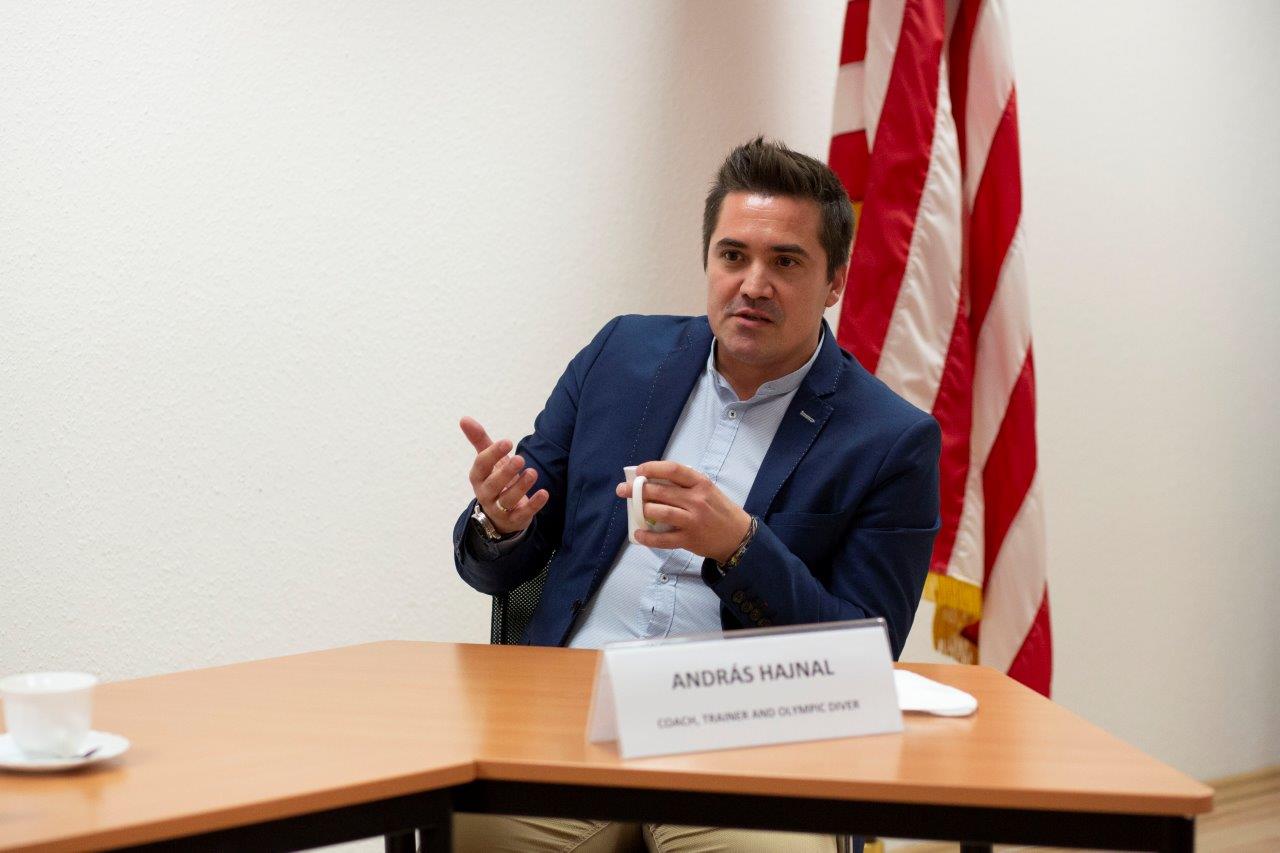
On career paths, Ms. Friedl said that Telekom realizes that people strive to develop themselves over time, regardless of their position, and even if they stay in the same one for a long time. They like to see a potential for progress and a vision – with a possibility for professional development. Ms. Friedl subscribes to the view that although the lack of a robust hierarchy offers fewer possibilities for moving upward on the career ladder, leaner organizations function better, and in lean organizations more horizontal, professional career paths should be developed and promoted.
On the other hand, Mr. Hajnal argued that it should also be accepted if people do not want to move up the career ladder. For these individuals, career paths can be frustrating. As Mr. Hajnal put it, it should be okay if someone is content with their position – but there is an important distinction to make. This unwillingness for upward movement must be a result of satisfaction with a current job, and not fear.
On the topic of performance management, Ms. Friedl said that the common practice of annual performance reports is fruitless. Since they are only done once per year, it is seen as a scary, long, bureaucratic procedure of ‘grading’ performance, and it puts HR in a bad light. For these reasons, Telekom has phased out the annual performance management report in favor of continuous, on-the-spot feedback. Ms. Friedl is of the view that although continuing with performance management reports will not ruin a company, phasing it out can create new, more effective cultures.
Mr. Hajnal also disagreed with the notion of these reports. He expressed that it is important how feedback is given, and many times HR leaders do not actually have enough information on their colleagues’ performance to assign ‘grades’ that are representative. As a coach and trainer, he highlighted the need to develop a so-called growth culture in people. This can be best achieved, in his opinion, by putting the emphasis on praising people’s effort, and not necessarily their natural talent when giving feedback. Agreeing with the main notion, Ms. Friedl added that there is a dark side to this mindset: if only the effort is important, some people may use that as a reason to devalue the importance of the end result. Thus, there needs to be a balance: people should be made to understand that it is okay to fail, but also that the end result is important.
The relationship between leaders and colleagues has also been a hot topic since the start of the pandemic – a good relationship has become much more important. Here, Mr. Hajnal argued that the first question to ask is whose agenda the company is operating on from an HR perspective: only the leaders’, or all colleagues’? Human connection is very important in this instance – leaders and colleagues must feel each other. One of the best ways to nurture such an atmosphere at the workplace is emphasizing the added value all employees provide through their work. Both of our speakers asserted that it is essential for HR professionals to let their colleagues know about this value, as it can be both a source of pride for employees and a large boon to their performance.
To sum it up, the main takeaway of the discussion is that the future of HR is one with less emphasis on old habits, and more on new, human-centered approaches.
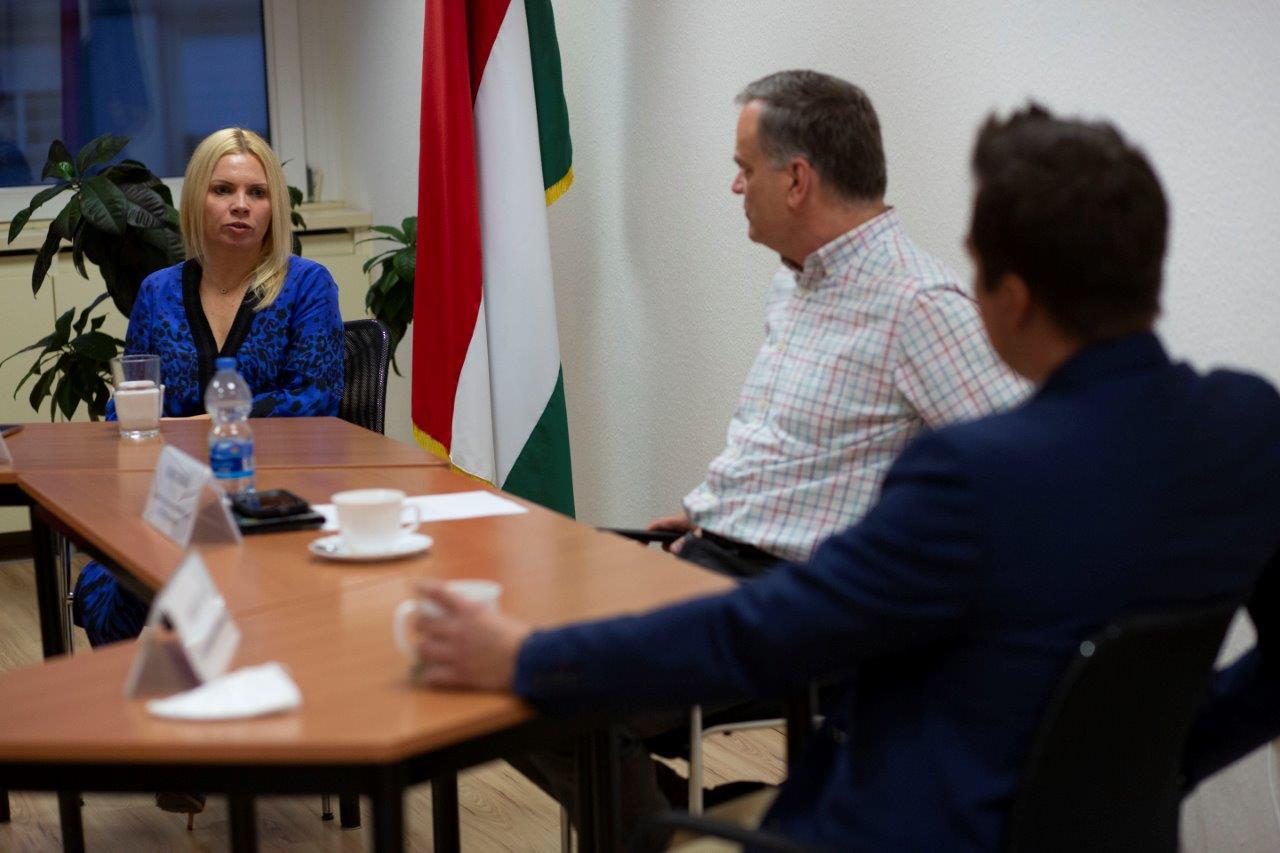
We would like to extend our thanks to Róbert Dobay, CEO at Menedzsmentor and Head of AmCham’s HR Committee for sponsoring, Vilmos Benkő, entrepreneur, founder of SPEAK Academy & owner of Rózsa Medical Center for moderating the event, and to our speakers and audience for their invaluable input.
Report by Thomas Kiss
SPECIAL OFFER
Book your online ticket for the remaining three sessions of the HR Academy for a discount price of 20000 HUF+VAT. zsofia.juhasz [at] amcham.hu (Contact Zsófia Valkó-Juhász) for details.