
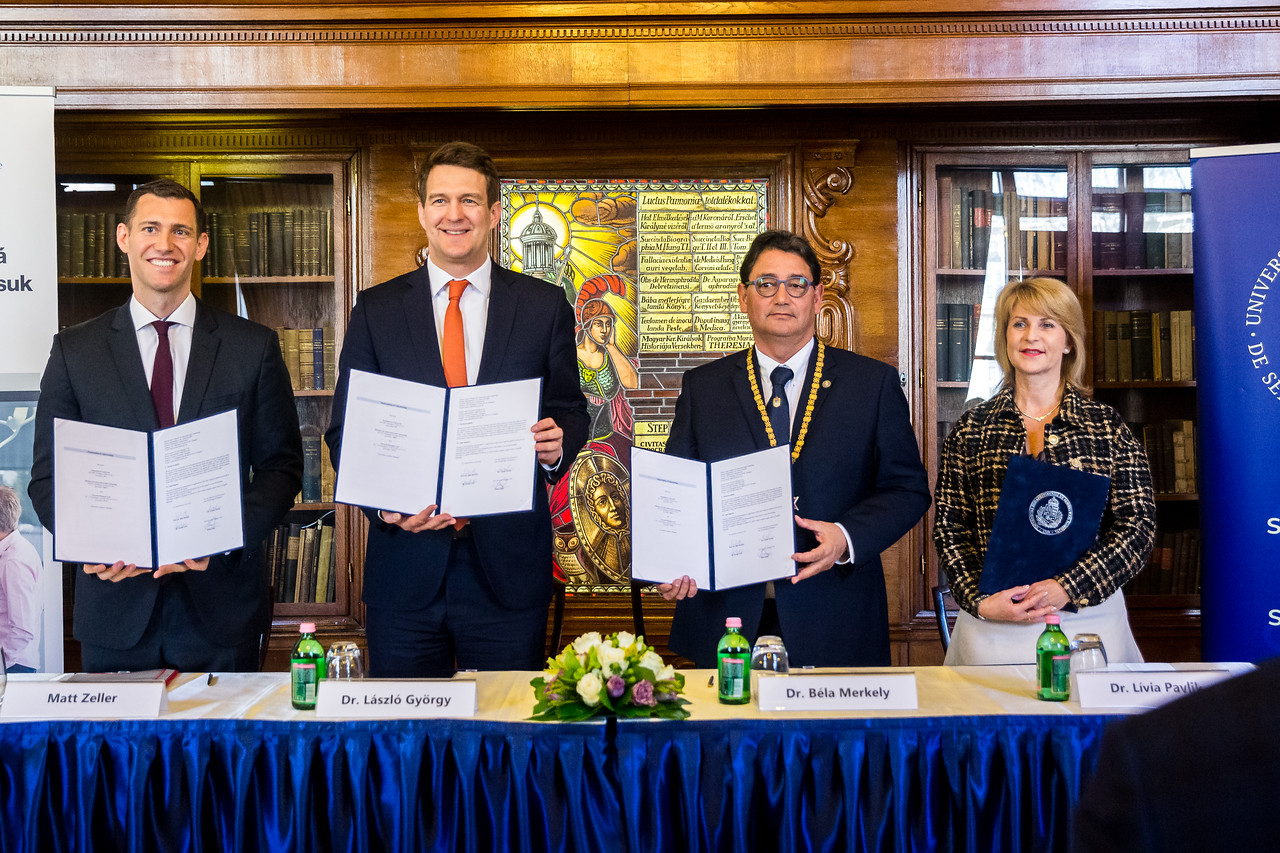
Semmelweis University (SU), the Ministry of Innovation and Technology (MIT) and Novartis Hungary have signed a “first of its kind” Memorandum of Understanding to drive innovation and impact the entire health ecosystem in Hungary. The three pillars of the collaboration are: expand access to and accelerate digitization of clinical research in Hungary, ensure pathway to Hungarian leadership in cell and gene therapies, and launch a “Cardiovascular Intervention Program” aimed at reaching 50k patients in the next 3 years, enabled by artificial intelligence and machine learning and focused on working together to bend the curve of CV disease in Hungary.
Budapest, March 21st 2022 - Semmelweis University, the Ministry of Innovation and Technology and Novartis Hungary have kicked off a new partnership to enhance innovation in Hungary and make an impact for a wide range of patients and healthcare stakeholders in Hungary. The MOU, a “first of its kind in Hungary” tri-lateral public-private partnership was signed today at Semmelweis University by László György, State Secretariat for Economic Planning and Regulation at MIT, Dr Béla Merkely, Rector of SU, and Matt Zeller, Country President of Novartis Hungary. The document envisages future cooperation in three areas.
“The results of the memorandum of understanding will not only create scientific research opportunities in the fields of cardiology and ophthalmology, but they will certainly benefit patient-care in a foreseeable future. This will mean an even closer scientific collaboration and innovation for our institute, which is an important aspect as well.” - said Dr Béla Merkely, Rector of Semmelweis University.
Pillar 1: Collaboration in clinical research
Strengthen collaboration between the signatories to increase access to new innovation with Semmelweis as a key regional site and to accelerate innovation in research through new technologies like trial digitization, new patient recruitment, and new digital interfaces etc.
Pillar 2: Leadership in cell and gene therapies
The signatories wish to demonstrate Hungarian innovation leadership in Europe and beyond by establishing SU as one of few centers in the world with capability to treat with multiple gene therapies. Semmelweis has established itself as a one of the leading treating centers in Europe using gene therapy to treat Spinal Muscular Atrophy (SMA) and will expand this leadership by helping to launch the new national newborn genetic screening program. While in Ophthalmology, screening to identify patients with genetic inherited retinal disease will be expanded and SU will establish a certified center of excellence treating retinal dystrophy including potential access in Hungary to the newest gene therapy options
Pillar 3: A Cardiovascular Intervention Program reaching ~50k patients in the next three years enabled by artificial intelligence and machine learning
Cardiovascular disease affects approximately 1 in 5 Hungarians, and while COVID-19 has been making headlines, CVD remains the largest unsolved public health emergency in Hungary and a Hungarian dies from CVD every ~8 minutes. The third element of new partnership aims to tackle CVD in an entirely new way, committing to new CV research and a focus on using new tools and experimentation with data & analytics, artificial intelligence and machine learning-based, HCP & patient education, and drug and non-drug interventions to answer that question of “how can we make an impact on CVD in Hungary”. The program aims to touch ~50k patients in the first 3 years and is solely focused on new ways to both prevent and treat CVD in Hungary on a nationwide scale and make an impact for thousands of Hungarians in the form of avoided heart attacks, strokes, and death.
Semmelweis is in the top 55 universities worldwide in the field of cardiovascular research, and is in top 15 in Europe - this relevance comes from the fact that cardiovascular diseases are the leading cause of death in Hungary. Hence continuous and innovative development of CVD care is critically important, as well as to be leaders in this discipline.” – added Dr Béla Merkely, Rector of the Semmelweis University, regarding the CV Intervention Program.
“This collaboration is the proof for the successful launch our new ways of working in higher education which results in a faster, more creative and modern ways of collaboration between higher education, private market and the governmental sector. The university center is going to be exemplary in gene therapies, digital clinical trials, utilizing AI in patient care – which are going to benefit patients and society within a short period of time.” – said László György, State Secretariat for Economic Planning and Regulation at MIT
"We are proud to be a part of this breakthrough partnership involving both the public and private sectors. The challenges facing the Hungarian health system today, especially in pressing disease areas like CV and rare diseases, require new approaches and innovation and we hope that this partnership can pilot new ways for the Hungarian ecosystem to make an impact for patients now and in the future." said Matt Zeller, Country President of Novartis Hungary.