
November 6, 2026
Hungary's economy continued to expand in Q3 2026, although growth lost momentum. GDP increased by 1.5% year-on-year and only 0.1% quarter-on-quarter, down from 0.6% in the previous quarter. The slowdown was primarily caused by drought-related weakness in agriculture and softer service-sector growth. Private consumption nevertheless remained robust and continued to represent the most important pillar of domestic demand.
Looking ahead, growth should remain supported by manufacturing exports and household spending. Export-oriented industries are benefiting from earlier large-scale investments, German fiscal stimulus, defense-sector demand and AI-related spillovers. However, the recovery remains highly concentrated among a limited number of multinational firms, while much of the domestic corporate sector continues to struggle with weak profitability and subdued investment activity
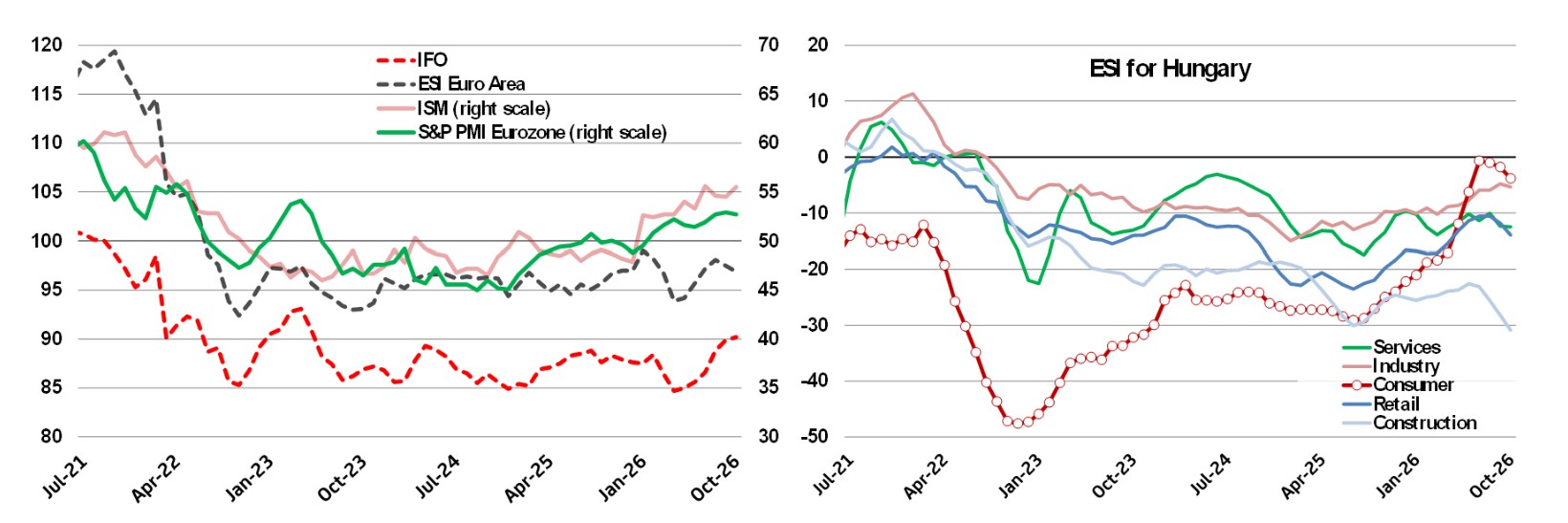
The major global sentiment indicators (left chart) point to improving optimism in Germany and the United States, while expectations in the euro area deteriorated. The three-month moving average of domestic confidence indices declined notably across all sectors except industry.
Source: IFO, ESI, ISM, S&P
Construction and investment remain the weakest parts of the economy. Order books, building permits and business surveys point to a prolonged period of subdued activity. While EU-funded infrastructure projects and RRF investments could lift growth from 2027, negative base effects, low profitability and tighter labor-market regulations continue to weigh on capital spending.
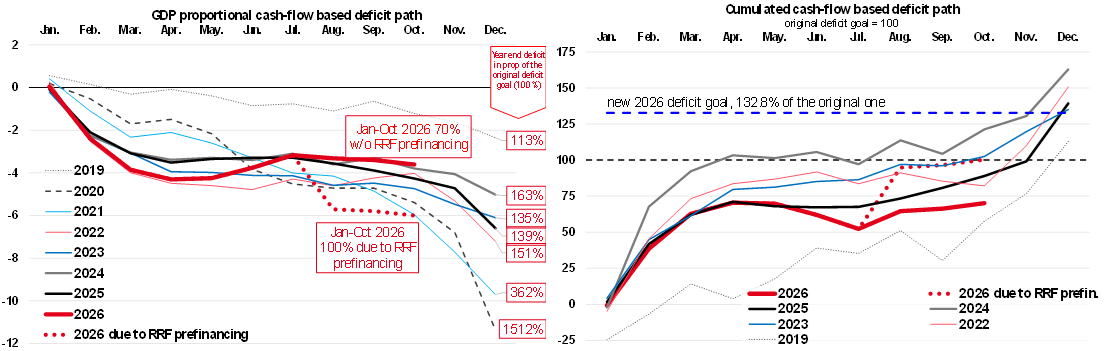
Fiscal developments were broadly favorable in October. The monthly deficit amounted to HUF 200.6bn, representing 76% of the revised annual cash-flow deficit target and only 45% when excluding RRF pre-financing.

The government maintains its 2027 ESA deficit target of 4.9% of GDP and plans to achieve consolidation through expenditure restraint, higher tax revenues, the introduction of a wealth tax and a restructuring of social transfers. The medium-term framework envisages a gradual decline in both the deficit and debt ratios, with the debt path turning downward from 2027.
The pre-financing of RRF projects generated a substantial budget deficit in August; excluding this one-off item, which is set to expire in December, underlying fiscal developments remained favorable in October as well.
Source: Ministry of Finance
Inflationary pressures remain contained but are gradually re-emerging. September CPI rose by 1.6% year-on-year, below consensus expectations of 1.8%, while core inflation eased to 1.9%. Lower food prices continue to provide disinflationary support, but higher global energy and commodity prices are increasingly feeding into producer prices. Inflation is projected to accelerate to 2.3% by the end of 2026, with annual average inflation of 1.8%. In 2027, inflation is expected to average around 3.3%, remaining above the central bank's target. Risks stem from price-cap removals, food-price pressures, excise tax increases and wage negotiations.
Monetary policy is likely to remain on hold. The National Bank left the policy rate unchanged at 5.5% in October. Although domestic inflation trends would justify easier policy settings, rising global yields, geopolitical tensions and financial-market volatility limit the scope for further easing. Overall, Hungary's outlook remains one of moderate growth, resilient consumption, gradual fiscal consolidation and a cautious monetary stance.
Contact UniCredit at Balint.Toth [at] unicreditgroup.hu (Balint[dot]Toth[at]unicreditgroup[dot]hu)
SAVE THE DATE! For Hungarian speakers - Join UniCredit Bank’s next Macroeconomic Outlook 2026 webinar, where our expert will analyze key economic drivers and their business implications, offering timely market insights, expert interpretation of major trends, and practical perspectives to support informed corporate decision-making.
🗓️ Date: December 1st, 2026 🕓 16:00-17:00
🎤 Presenter: Zsolt Becsey, Chief economist
Registration link: Regisztráció
On the date of the event, join us on the following link: Belépés