
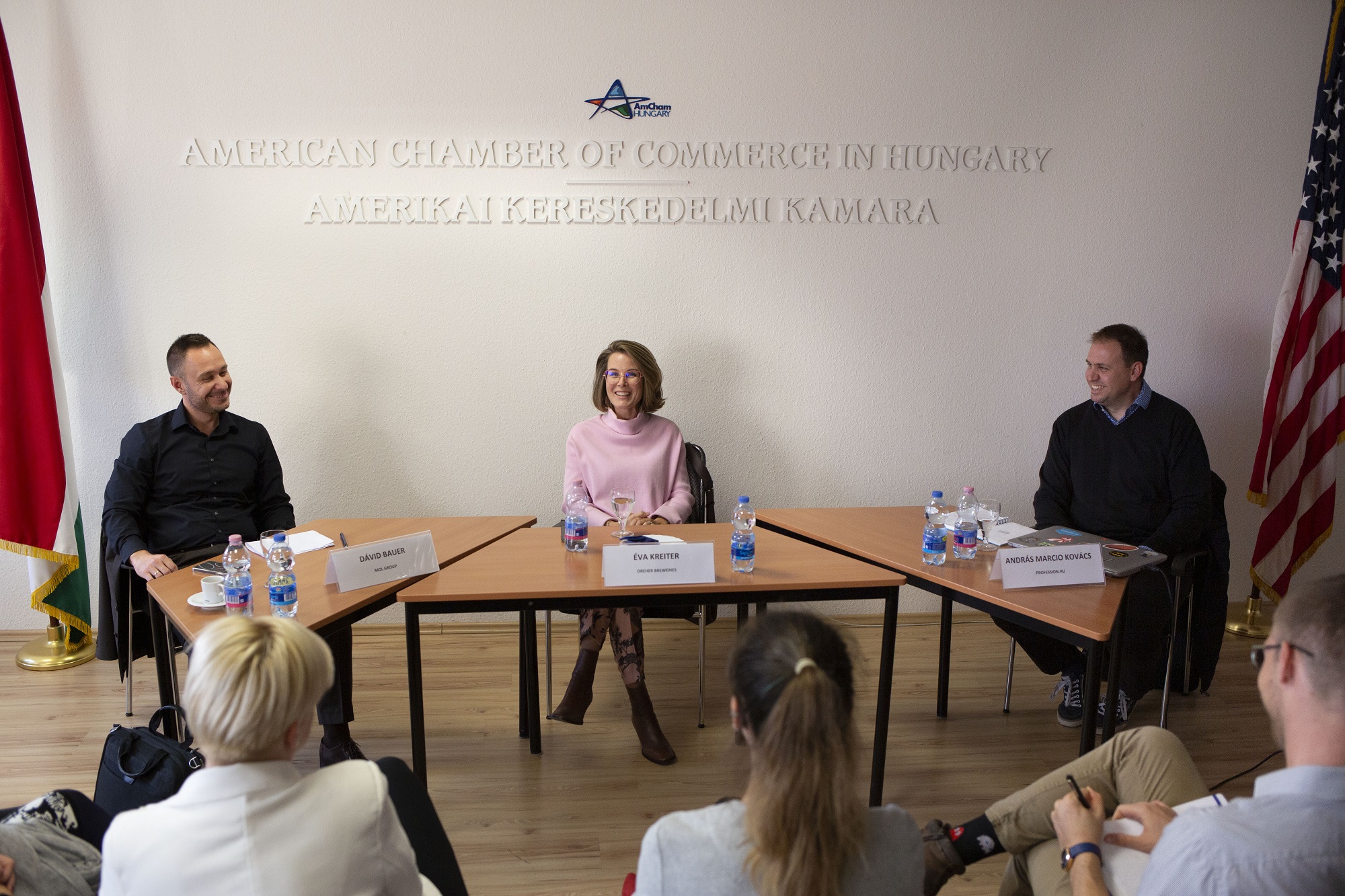
On 26 October, we held the inaugural session of our returning HR Academy event series at the AmCham Office, the topic of which was Recruitment and Onboarding during the COVID-19 pandemic. Our guests for this session were Dávid Bauer, Head of HR at MOL, Éva Kreiter, Director of HR at Dreher Sörgyárak ZRT., and András Marcio Kovács, Key Account Team Leader of Profession.hu, who moderated the discussion. The event is part of an ongoing five-part discussion that aims to highlight best practices in recruitment, performance and talent management, development and training, motivation, employee experience, and other areas of HR.
The pandemic has undoubtedly altered our professional lives significantly, and HR is no exception to this development. The pandemic caused a global shortage in labor force – making its impact on HR managers’ work significantly larger. Due to this shortage of labor, companies must pay more attention to the needs and desires of their labor forces – explained Róbert Dobay, CEO at Menedzsmentor and Head of AmCham’s HR Committee in his opening remarks.
András Marcio Kovács, who moderated the discussion, said the employment market is currently in overdrive, which naturally brings forth numerous questions. In 2020, according to Profession.hu’s data, there was approximately a 20% drop in job listings on the website compared to the year prior. However, the job market was able to rebound and currently, there is about a 70% increase in job listings this year compared to 2020. Our two panelists were asked to summarize their respective companies’ main challenges in navigating these tumultuous past few years from an HR perspective.
Dávid Bauer explained that the social restrictions brought about by the pandemic were an especially problematic issue at MOL, since the company is a supplier of energy – thus, it cannot simply cease its operations. This, coupled with the fact that the company’s energy production systems are very complex and need significant experience to oversee and to operate, resulted in a situation in which the company could not, and wanted not to lay workers off. Although for example, the entire HR department could work from home, blue-collar jobs required physical presence, which resulted in numerous challenges.

Éva Kreiter remarked that the situation was similar at Dreher, although for a different reason. Dreher is a production company, which similarly cannot cease operations in production. The biggest challenge however was not the question of the blue-collar workforce, but those at the sales department, as there were over 300 employees the company could not provide work to due to the pandemic restrictions. Yet, Dreher strived to avoid layoffs – in the end, salaries in the sales department were decreased. The essence of the challenge, according to Éva, was balancing: how to handle all employees equally, and still keep operations ongoing.
On the question of how did the new challenges shift over time, Éva Kreitler argued that some jobs at Dreher need to be replaced, which is hard; in addition, the company needs more ‘simple’ (mainly blue-collar) jobs, which is also a challenge of its own. At MOL, the main challenge was keeping the blue-collar workforce. To that end, the company introduced career path programs for these employees, with significant success. On the other hand, the company is struggling much more when it comes to the white-collar workforce.

As to how the two companies' strategies had to shift, Éva Kreitler argued that not much has actually changed at Dreher in this regard. The company’s HR department was expanded just before the pandemic, and digitalization was already a cornerstone of strategy. As such, the HR department was able to shift to the online space in just two weeks. Dávid Bauer expressed that MOL also had several programs already implemented regarding digitalization, so they were nicely prepared for the new challenges, too. One exception was contract management – part time management needed to be managed remotely in digital format. Finally did successfully.
The last part of the event was a Q&A discussion, where the two panelists were asked for their input on several questions. On the question of referral programs, both panelists subscribed to their usefulness, although Dávid Bauer argued they have use in some places, while not so much in others. Regarding the specification of salary ranges in job listings, both panelists argued these numbers will need to be indicated in the future when companies look to fill job openings.
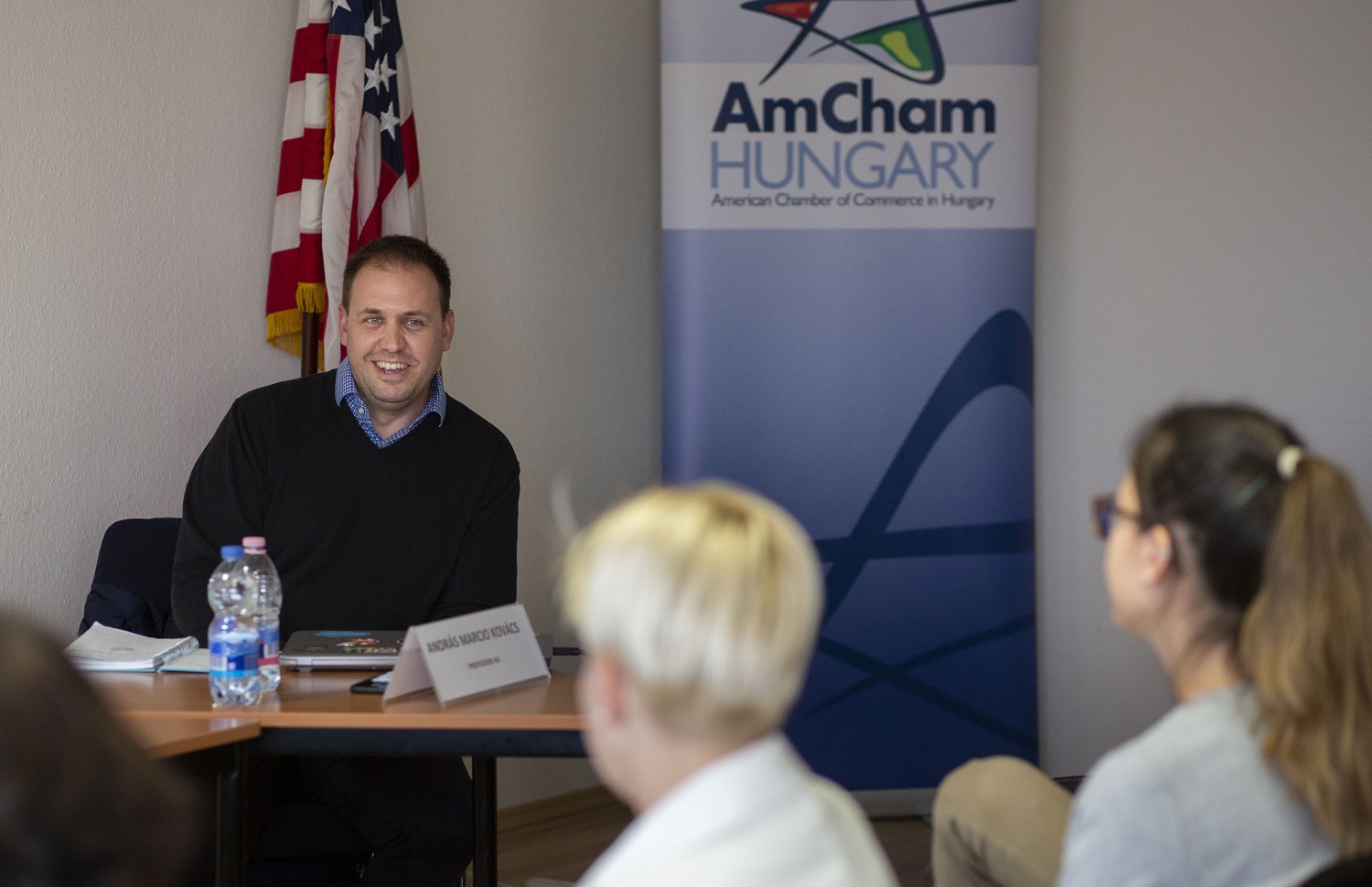
In the end, both panelists agreed that due to the competitiveness of the market, the key to success is talent – HR leaders will need to work as hard as possible to acquire it.
We would like to extend our thanks to Róbert Dobay, CEO at Menedzsmentor and Head of AmCham’s HR Committee, and András Marcio Kovács Key Account Team Leader of Profession.hu for moderating the event.