
In accordance with our efforts to put sustainability on the forefront of our advocacy work and our nation's economic policy, we launched AmCham’s European Green Deal Working Group this March to help our members get a better understanding of the policy initiative and related EU and Hungarian legislation, while also providing a platform for corporate best practices. Following our first two meetings on clean energy and circular economy, on June 14 we discussed sustainable mobility with keynote speakers Dr. Barbara Botos, Deputy Secretary of State for Climate Policy, Ministry for Innovation and Technology and Khurram Gaba, Policy Planning Executive, ExxonMobil.
The Deputy State Secretary gave a policy update on the Hungarian government’s plans on Sustainable Mobility in the EU Green Deal framework with special focus on the Fit for 55 package which includes proposals among others on the EU ETS, ESR, LULUCF and CBAM and is expected to be published in mid-July.
The Council of the European Union decided that the previous gross 40% emission reduction target compared to 1990 for 2030 should be increased to at least net 55% which was supported also by Hungary. In order to achieve the 2050 climate neutrality target, a stronger effort will be needed on a national level, such as improving energy efficiency and promote electrification, encouraging decarbonization efforts in all sectors and investing in research & development is essential in the field of carbon capture, storage and utilization, hydrogen and energy storage.

Following the Deputy State Secretary, Khurram Gaba, ExxonMobil’s Policy Planning Executive joined us from London to provide an EU perspective on the role of low carbon liquid fuels in the future of transport. He presented an interesting comparison in greenhouse gas emissions from the transport sector and highlighting that liquid fuels offer most affordable and widely available transport energy.
“Society will continue to rely on liquid fuels in transport. Low carbon liquid fuels optimized with more efficient engines offer effective CO2 reduction, alongside other pathways. There are several innovative approaches to low carbon liquid fuels. A supporting policy framework is required to incentivize the investment needed to bring such fuels to market at scale” – highlighted Mr, Gaba.
- Creation of a market for low-carbon combustion fuels, with high price signal to stimulate investments
- Either a dedicated cap & trade mechanism
- Or a low carbon fuel standard
- Amendment of vehicle standards, to recognize WTW CO2 footprint of fuels
- Reform of fuel taxation based on carbon intensity
Following their remarks, a roundtable discussion gave floor to corporate best practices in mobility with Continental Automotive, MOL and Siemens Mobility.
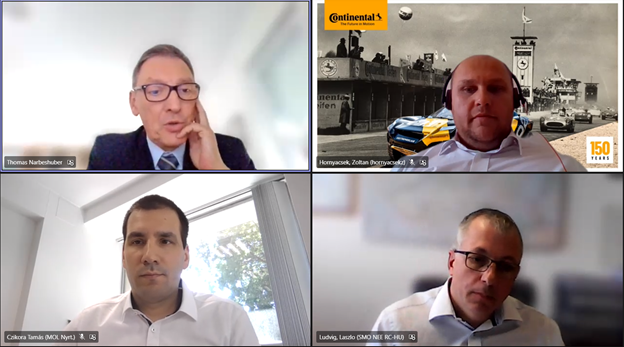
László Ludvig, CEO of Siemens Mobility introduced their vision and practices of sustainable mobility solutions in the train system. He pointed out that beside enhancing efficiency by providing sustainable technologies their goal is also making production sites carbon neutral and create a sustainable supply chain management.
Tamás Czikora, the Head of Mobility Division of MOL Group presented the wide range and different solutions provided by MOL for different mobility needs, from micromobility, such as Bubi bike sharing, Limo car sharing, Plungee, the fast charger and electric vehicle charger network, to the 2000+ services & fuel stations.
From 2016, MOL Group’s strategy is “selling kilometers not liters of fuel” by becoming an integrated, complex mobility service provider by 2030.
Finally, Zoltán Hornyacsek, talked about Continental Automotive’s role as an ambassador of sustainability by introducing Extreme E. Extreme E is the first sport car built out of concern for the climate crisis. The series’ goal is to use electric racing to highlight remote environments under threat of climate change issues, and to encourage us all to take positive action to protect our planet’s future.
With 30 percent of the planet’s CO2 emissions coming from transport, Extreme E exists to showcase the performance of electric vehicles, using the powerful mix of thrilling sports action, scientific education and storytelling to accelerate their adoption in order to reduce CO2 emissions and achieve a more sustainable lifestyle.