
AmCham welcomed Minister for National Economy Márton Nagy to its Business Forum organized on February 1, 2024.
Nagy began by welcoming the market’s positive reaction to the news announced that morning that the European Union had agreed on a HUF 50 billion package of aid for Ukraine, funding for which had been blocked at an earlier summit in December by a Hungarian veto.
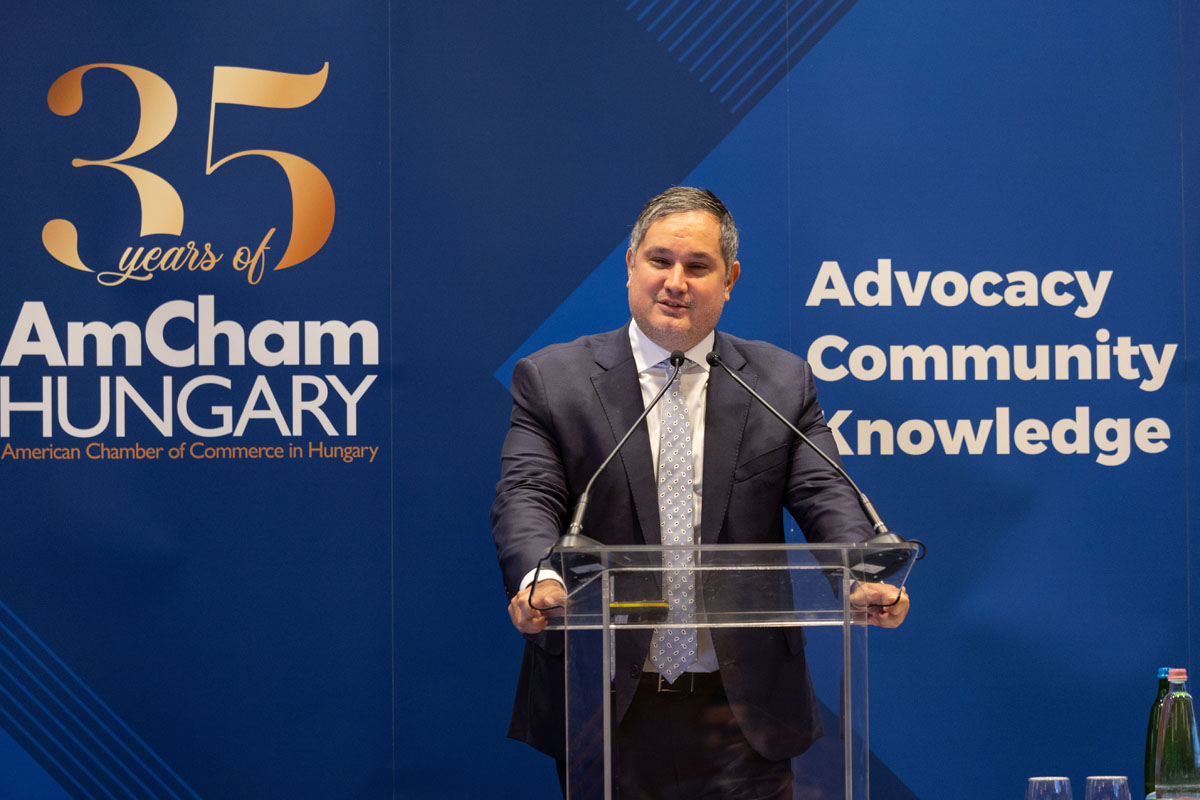
His presentation outlined measures the government is taking to support economic recovery this year. But first, Nagy wanted to underline the importance of America to the Hungarian economy. “The United States is now the third biggest investor in Hungary related to FDI stock,” he said. “That makes the U.S. a very important counterpart. The economic cooperation is strong.”
American firms in Hungary had created 89,000 jobs and generated a net revenue in Hungary of HUF 7.753 trillion, according to 2021 figures, the minister said. The trade balance was improving in Hungary’s favor, and the United States was the second most important trade partner after Germany.
One challenge for the relationship was the termination of the United States-Hungary taxation treaty, which took effect from Jan. 1 and which Nagy described as “a political question rather than economic.” Speaking for the government, he accepted that “we have work to do” to restore the treaty but asked that U.S. companies based here also help ladvocate for it.
Returning to his central theme, he said the economy would perform much better this year, provided domestic demand, which had remained sensitive to factors such as the price of food, could rebound.
He also noted that the economy could be further supported by credit markets, EU funds and foreign direct investment. Economic policy would help by targeting three areas: growing household consumption, stimulating domestic production and investment, and finding reserves in the labor market. Household consumption is doubly important because it also affects how much comes into central budget coffers in the form of value-added tax.
“The Hungarian taxation system is consumption-based. This is not true for every other country,” the national economy minister pointed out.

Building a Virtuous Circle
Nagy said 2023 had seen a “very negative scenario,” with real wage growth contracting at a rate not seen since 2009-2011. What was required now was a virtuous circle where growing earnings would support greater consumption, which would help domestic industries grow and invest, spurring growth in company profits and thus allowing for real earnings to grow even further.
Nagy cautioned that a degree of patience is also required, as there is usually a six-to-nine-month delay between a return to positive real wage growth and an increase in retail sales.
The government has several programs to help stimulate domestic production and investment, including subsidized credit through the Széchenyi Card, the HUF 700 bln Baross Gábor Reindustrialization Program, a HUF 33 billion scheme targeting local food suppliers, and EUR 5 bln in GINOP Plus (Economic Development and Innovation Operational Program) funds.
Regarding the labor market, a crucial area of focus will be increasing the activity rate from the present 77.8% to a target of 85%.
Beyond that, the other resource, where no Hungarian workers could be found, would be regulated numbers of guest workers. Nagy put their level at 121,000 last year, including some 45,743 Ukrainian and Serbian citizens who do not need special permission to work in Hungary.
Successfully targeting these three areas – domestic consumption and investment, the labor market and attracting even more FDI – would lead to restored economic growth in 2024, Nagy insisted.
The Minister's speech was followed by a Q&A section with the audience, addressing among others women's employment, investment and digitalization.

*
As part of AmCham's advocacy work, we have compiled a position paper assesing the effects of the cancellation of the U.S. - Hungarian Double Taxation Treaty as well as the benefits of a treaty of this kind that has been sent to the respective ministers and decision-makers. Moreover, AmCham has emphasized the importance of a new convention on several platforms (Business Forums, position letters, in meetings, and through interviews) and engaged in a dialogue with both the U.S. and Hungarian decisions makers. Furthermore, we are also preparing with our new Recommendation Package 2024-2025 to continue a constructive dialogue between business and policymakers, and to improve the long-term performance of the economy on various levels, to be published soon in the spring.
For more photos, please visit the gallery.
The event report is based on BBJ's publication (VOL.32, Number 3)