
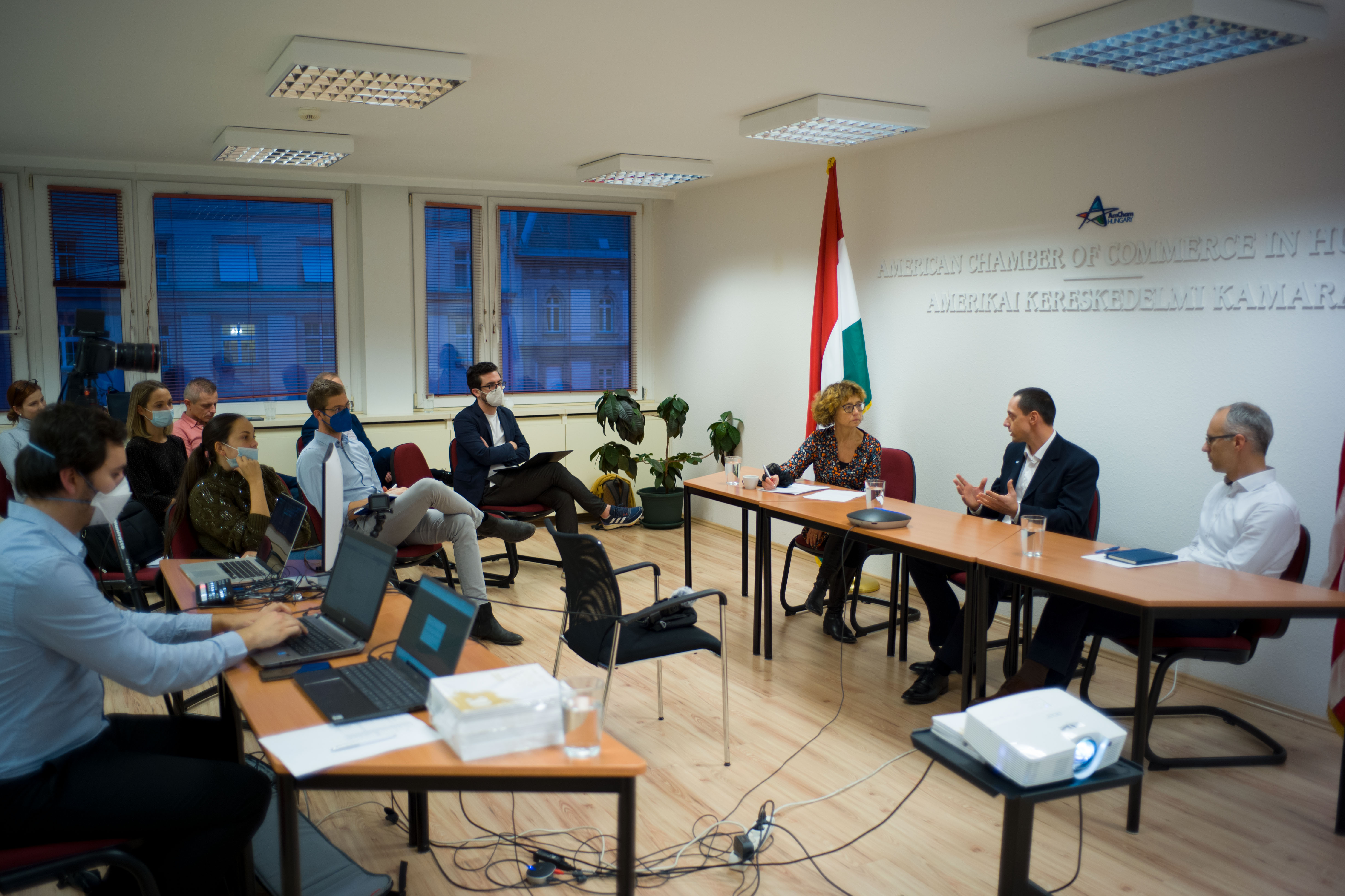
On 19 November, we held the fourth session of our HR Academy event series, dedicated to highlighting best practices of industry leaders and providing useful tips for HR professionals to help build the foundation of their success in the post-pandemic world. Due to the current uptick in the virus’ spread, participants had the choice of attending either in-person at the AmCham Office or online. Our guests for this session were Balázs Fremda, Head of HR at Morgan Stanley, and István Lenk, Managing Director of Eaton Hungary, who shared their experiences regarding diversity management in the workplace. The discussion was moderated by Dr. Andrea Juhos, Managing Partner at Lee Hecht Harrison Hungary.
Why is diversity important in the workplace? This was Ms. Juhos’ first question to our panelists. As Mr. Fremda put it, Morgan Stanley has recognized diversity as a beneficial core value. That happens to align with his personal beliefs, too, he said – that we must build an environment in which people accept each other for what they are. For Mr. Lenk, the situation is similar. Both he and the company see diversity as an opportunity– open doors provide more perspectives for both the company and its employees, from decision-making to professional life. Within Eaton, the first official Global Inclusion and Diversity report was published that also confirmed the advantages of this diversity-focused mindset.

On the question of whether Morgan Stanley is actively training its leaders in managing diversity, Mr. Fremda said the company is going to great lengths to make such training available for all employees. For example, leaders had to participate in mandatory sessions where practical questions related to diversity-oriented thinking were discussed, and every employee had the chance to take part in sessions where practical solutions to diversity-related real-life situations were considered. The latter even involved professional actors. At Eaton, Mr. Lenk said employees receive a brief on the company’s core values on their first day. Furthermore, there is training held by board members and senior leaders which is compulsory for every senior manager, and many mid-level managers. In the course of these, real-life examples are processed as case studies.
In the next part of the discussion, Ms. Juhos and our panelists touched upon the most common stereotypes of certain segments of society, and gave best-practice recommendations in combating these.
Employees of older age are often seen as unable to learn and unable to advance in their career further. Mr. Lenk argued that this is a wide-ranging problem in the shared service sector in Hungary, as these people are often hard to discover, and knowledge in languages and certain skill sets are essential nowadays, which people of older generations may not possess. Mr. Fremda added that in many cases, older people do not apply for certain positions at all. At Morgan Stanley, certain programs are aimed at addressing this issue, like offering internship positions for older people. There are also positions, he continued, where older people may actually fit better. The company aims to highlight these cases when possible to fight the stereotype.
As for the status of women within their companies, Mr. Lenk offered the example of Eaton’s ‘Women Added Value at Eaton’ program, which advises on the advantages of including more women in all levels of the professional ladder. Mr. Fremda also highlighted the importance of this issue at Morgan Stanley, and said they offer policies, content and employee groups beneficial to women. Women returning from parental leave also often fall victim to stereotypes that assume they cannot provide as much value as other employees. Mr. Lenk thinks the key to solving this issue is flexibility. At Eaton, flexible work opportunities are provided up until senior manager levels; before the pandemic, the company’s office even featured a special family room where even babies could be tended to by their mothers, while the latter could simultaneously fulfill their professional responsibilities. Morgan Stanley also offers numerous possibilities for returning women, such as the ‘Return to Work’ program, offering flexible work opportunities, Mr. Fremda said. Furthermore, the company also emphasizes mental health through its ‘Parental Transition Support Program’, where new parents can discuss the novel challenges they face due to parenthood.
Both leaders expressed their support for employing non-Hungarian people. Apart from the aforementioned addition of multiple perspectives, there are also some shortages on the job market which Hungarians cannot fill – but people from abroad can. To make these workers feel more at home, Eaton is regularly organizing community events as part of its ‘Global Village Program’, where employees of different backgrounds can showcase their unique cuisine. In turn, Morgan Stanley helps newly arrived employees along the path of their integration by offering them assistance in various tasks.
Our panelists also talked about various other societal groups, such as members of the LGBTQ+ community, the Roma, people with disabilities, and people changing careers in their mid-life. Mr. Fremda and Mr. Lenk highlighted their companies’ relevant programs, their successes and challenges, and affirmed their steadfast support for creating appropriate opportunities for these groups.
Diversity is rapidly becoming one of the defining characteristics of the current era in many respects. Globalization has brought about a diverse, complex world economy – a fundamental part of which is an equally diverse workforce. Today, management of this workforce often constitutes a grand challenge to employers. If, however, that management is done right, diversity can be a boon both to the workforce and to employers as well – such was the overall message of our panelists.
We would like to extend our thanks to Róbert Dobay, CEO at Menedzsmentor and Head of AmCham’s HR Committee for sponsoring, Dr. Andrea Juhos, Managing Partner at Lee Hecht Harrison Hungary for moderating the event, and to our speakers and audience for their invaluable input.